
Launching a Good-Eating-Quality Hybrid in the Philippines
The Challenge
Mahyco International Pte. Ltd (mipl) was entering the Philippines market with a hybrid rice seed brand for the first time. There was no social media presence, no audience, no recall or recognition, be it for the brand or the company behind it.
However, the opportunity was real. The Philippines has about 5 million hectares of agricultural land under rice cultivation with only 30% of hybrid seed adoption. Additionally, there is also a full government subsidy on hybrid seeds. Digitally, this market has the highest penetration of Facebook in Southeast Asia. However the Filipino farmers are not really influenced by Advertising. Land holdings are small, farmers are trade-savvy and retailers carry little influence on buying decisions. The trigger to decision-making is peer proof and demo plots. The communication challenge was a relatively unknown brand claiming ‘Good Quality Eating’. The benefit was primarily sensorial.
The Product Truth
MHC 2 is about Good Eating Quality.
Taste, aroma and quality in the bowl and not just yield in the field. In a category that sells almost entirely on tonnage, MHC 2’s advantage was sensorial, and it reached beyond the farmer to the family at the dinner table.
The Idea
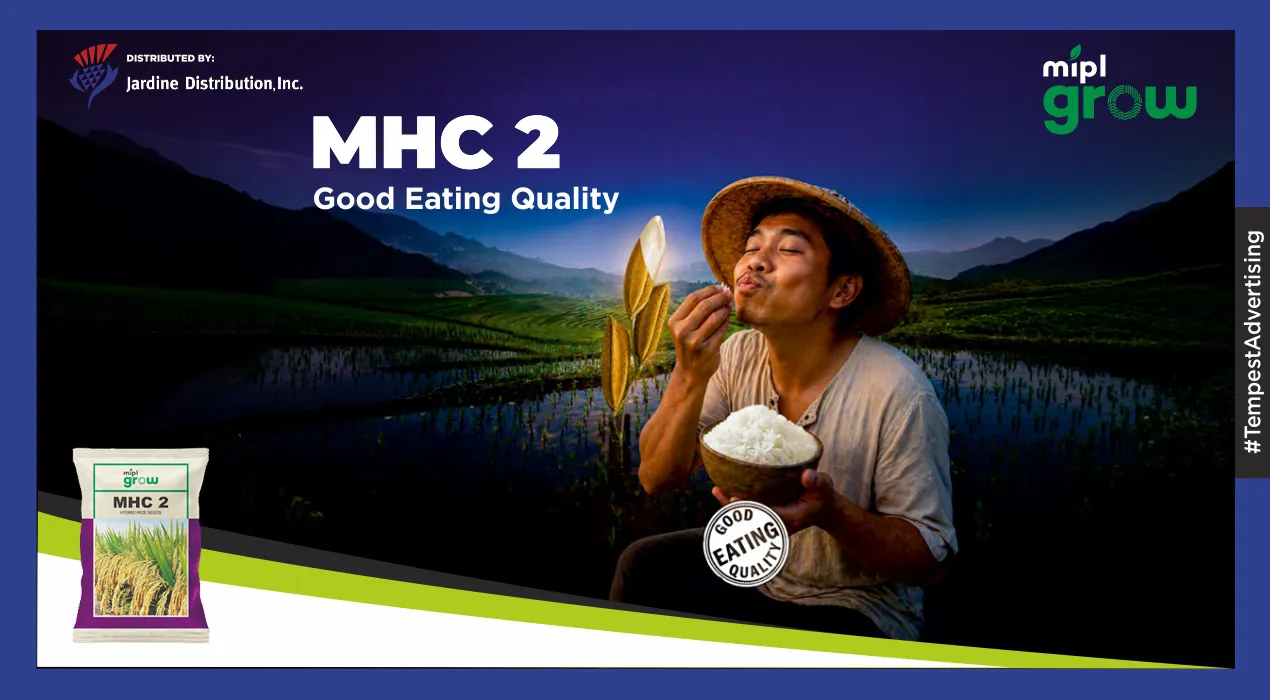
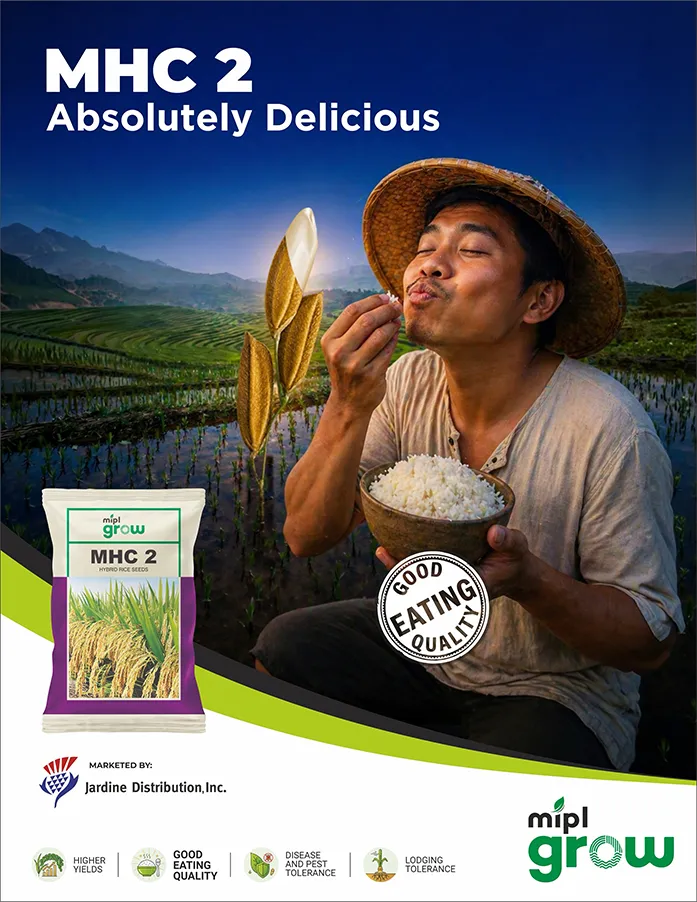
Move the camera off the product and onto the reaction to it.
Sensorials like aroma, good eating quality is difficult to communicate . You cannot shoot softness or taste. Also the close-up of white rice looks the same whichever seed it came from.
So we made the farmer’s face the hero. The pause at the first mouthful, the closed eyes, the finger-kiss – a gesture that crosses every language in the market and needs no caption in either. The rice appears too, shot close and generous, steam and grain, quality you can read at a glance. You cannot put aroma in a poster. You can put the reaction to it, and let the viewer supply the rest.
The claim was kept as plain as the promise: Absolutely Delicious. Good Eating Quality stamped on the pack like a seal, with the agronomic reassurances – higher yields, disease and pest tolerance, lodging tolerance held back as supporting proof rather than the headline.
The Craft Decisions
We cast a real Filipino farmer in a real paddy, not a model in a studio. And every post ran in both Filipino and English — the flavour of the local tongue, the authority of the trade language.
Here, the progressive farmers are the real influencers. We showcased growers standing in their own crop, talking eating quality and yield in plain language. The intent was Peer proof, not polish.
The Impact
The communication reached 237,490 people across its two awareness ads, at ₹16.65 per thousand reached, with the farmer film alone reaching 119,024 people, more than any other ad in the campaign.
Organically, two MHC 2 posts crossed 135,000 views each. 140,591 on the pack-led film and 135,845 on the farmer eating — for over 276,000 views, 798 engagements and 33 shares on the eating-quality story.
The sharpest signal wasn’t in the dashboard. It was in the comments. Farmers asked the question that only comes from real intent — “Magkano binhi per kilo?” — and got a straight answer: PHP 1,250 for 3 kilos, with a dealer number attached. Others asked “Saan makabili ng seeds?”. Messaging conversations to the page more than doubled.
The Takeaway
In a category that argues about yield, the sensorial claim is the harder sell and the more defensible one. If the benefit cannot be photographed, photograph the response to it and let farmers who have already tasted it do the convincing.