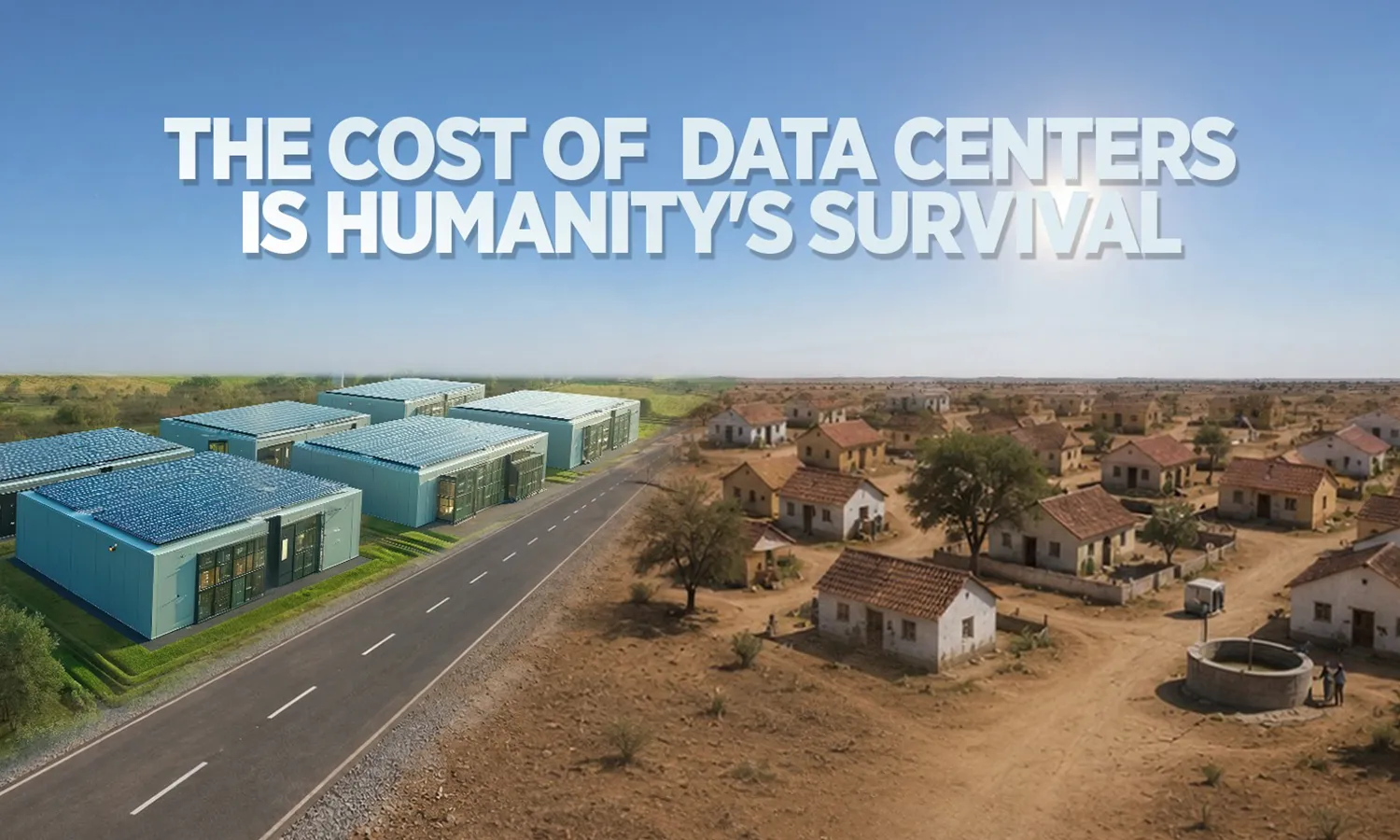
Every search query, every AI prompt, and every generated image runs through a physical data center that consumes electricity and constantly needs water.
According to research by University of California, Riverside, 40 to 100 average prompts consume about 1 litre of water. Morgan Stanley projects AI-related data centres could consume more than 1 trillion litres annually by 2028, an elevenfold increase from 2024.
Most brands, businesses, and marketing and advertising agencies are yet to reckon with the environmental cost of the digital infrastructure they depend on daily.
As AI demand grows, data center water consumption is no longer a footnote in a sustainability report. The AI environmental impact extends far beyond carbon. It's now a water and human rights crisis.
Data centres generate enormous heat. To keep servers running, they are cooled in two main methods:
Most large-scale facilities use evaporative cooling. The water is permanently displaced from the watershed it was drawn from.
Standard computing is one thing. AI energy consumption is a different crisis:
The AI infrastructure is expanding fast. The question is - who pays the price?
Data centers need cheap land, power, and water. Developed nations are increasingly pushing back:
So big tech looks to developing regions already facing water scarcity:
Communities in these regions are no longer just losing water to local industry. They’re losing it to infrastructure built for users on the other side of the world.
As a digital marketing and advertising agency, Tempest believes that brands and agencies need to drive digital growth in a sustainable manner.
It’s still not too late. Better infrastructure choices can be made to ensure that sustainable data centers are adopted for the future:
The technology for green data centers is available. The gap is in governance and will.
Digital growth still lives in the physical world. Every prompt answered, every gigabyte stored, and every model trained has a material cost in energy, land, and water.
As brands, businesses, and consumers push for more AI, faster computation, and a seamless digital experience - the infrastructure behind is already resulting in an environmental and a human rights crisis.
We must collectively demand better regulation from local and global governance, and prioritize quality of life over quality of AI.
Tempest Advertising is a full-service advertising and digital marketing agency with offices in Hyderabad, Pune, Bengaluru, and Mumbai.
Brands become top brands when a top advertising and digital marketing agency puts efforts into a planning strategy and deriving ideas that will flourish with time. Tempest assures the same and hence is regarded as the top advertising and digital marketing agency in Hyderabad, Pune, Bangalore and Mumbai.
102, Sai Sagar Heights,
Prakash Nagar,
Opp, Begumpet Airport,
Secunderabad 500003,
Telangana, India.
No. 18, Niketan B,
Prabhat Road, Lane No. 10,
Erandvane,
Pune 411004,
Maharashtra, India.
Berachah,
#6, Stephens Road,
Frazer Town,
Bengaluru 560005,
Karnataka, India.
4, Common Wealth CHS Ltd,
1st floor, Opp Shopoers Stop,
Linking Road, Bandra West,
Mumbai -
400050,
Maharashtra, India.

For two decades now, we at Tempest have been building brands and making a difference to people's lives through advertising.
© Tempest Advertising 2024.